The Rowdy Goddess

An Ecstatic Vision of the Goddess, dancing in harmony with the Universe.

Tea, Hot Water, and the Goddess

Tea, Hot Water and the Rowdy Goddess!

“A woman is like a tea bag. It’s only when she’s in hot water that you realize how strong she is.”
This quote, attributed to both Eleanor Roosevelt and Carl Sandburg, attracted my attention because I want to write a book on the Magick of Tea; so I collect information, lore, superstition and magical attributes of tea. If I had included it in the Crone posting, I’d be making smart-aleck remarks about old bags. Another day for that!
Tea & the Goddess
Tea is wonderful not only for its flavor, aroma and health benefits, but because its history is also so rich. The history of tea is full of legend, corruption, and political intrigue. The tea trade was enormously influential in the history of Europe and the history of its land of origin, China.
And always, when I’m researching something, I’m looking for the Divine presence in the lore and uses of it. For tea, topping the list is Kuan Yin, the bodhisattva of mercy. Some people will be quick to correct you and tell you that She is not a Goddess. To me she is, and she has been revered in such a way, that she is a goddess. Her mercy and compassion speaks to everyone. The oolong tea, Tieguanyin Oolong Tea is named for her and is one of the most prized teas growin china.
How it became named for her is a beautiful story of devotion. Centuries ago, there was a tea farmer named Mr. Wei. He was very poor and worked very hard to create a living for his family. Each day, both morning and evening, he would pass a neglected temple, the Temple of T’ieh-Kuan-Yin. The degraded state of the temple awakened his devotion to Kuan Yin and he began to light incense and pray at the temple; each day doing a little clean-up and polishing of the temple and the statue of Her.
Moved by his devotion, Kuan Yin appeared to him in a dream. She said to him, “Beind the temple, deep in a cave is a treasure for you and the generations to come. You must share it with all of your neighbors.” Upon awakening, he rushed to the cave and searched and searched. He found nothing be a small sprig of tea. Unhappy that he did not fulfill Her instructions, he took the sprig of tea back to his home and planted in his garden. He tended it and it grew over the years into a bush. He noticed that as he created infusions that the fragrance was beautiful and long-lasting.
He began to cultivate the tea bushes and shared the shoots and seeds with his neighbors, naming the tea after T’hei-Kuan-Yin. The temple was repaired and funds were set aside for its perpetual upkeep. The region flourished as tea traders flocked to the region to buy this lovely tea.
Tiequanyin is also called Iron Goddess Tea and the less romantic researchers say that it is called this because of the appearance of its processed leaves, “dark as iron and heavier than other teash, but with the quality as pure and beautiful as Guanyin.” Well, maybe there is more poetry in that statement. [quote from All the Tea in China by Kit Chow and Ione Kramer]
Kuan Yin inspires devotion all over the world from traditional Buddhists to the pagan and Goddess communities. She is the embodiment of compassion (Karuna) and mercy. She is Mistress of the Southern Seas and is often depicted riding across the ocean either in a lotus or on a dragon. She holds a vase with the nectar of compassion and wisdom, and she is also shown with a Willow branch from which she sprinkles the divine nectar of life. She is the bestower of children and the dove is the symbol of her fecudity. She is also shown with a book or scroll of prayers, representing her mastery of dharma (teaching) and text (sutra). She is shown with a rosary which she uses to call on the Buddha for succor on behalf of all who call her name.
There is strong trust in her grace, mercy and healing powers that to call her name is to call her to you. Om Mani Padme Hum is her mantra and it means “Hail to the Jewel in the Lotus.”
People tend to look at her as very holy and without fault since she is deserving of nirvana and chooses to stay and help others achieve enlightenment. She has been in my life since I was a girl. My great-aunt and my grandmother collected images of her, referring to her by one of her other names Mei-Ling. When my grandmother passed away, I inherited her collection of figurines along with her love of this wonderful Goddess. Whenever I do Reiki healing and teaching, Kuan Yin is the Goddess who appears. To me, though, there is an element of playfulness about her. She isn’t completely somber and serious. In my work with her, I’ve learned she enjoys a good joke, likes physical exercise and loves cats. Her mastery of dragons resonates with me and tells me that her strength comes not from holy stillness but an active, strong physical presence. She is vibrant and vital as she appears to me.
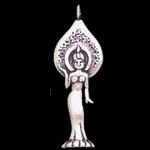
For my birthday, Mouse gave me a wonderful Kuan Yin pendant from Jane Iris [www.janeiris.com] that is shown in this blog entry. I love that she has perky breasts and tips her hip’ she looks saucy! A boddhistava that wants to have fun…..It shows me that Kuan Yin has her connection to the exuberant, ecstatic flow of energy in her being and she continues to communicate that fabulous energy to us. So every time you breathe in the delicate fragrance of Oolong tea, find the essence of the Goddess there as well.
Oolong Tea
There a lots of varieties of tea, and oolong is a delicate variety somewhere between black tea and green tea in its oxidation. The flavor is somewhere between black and green, favoring the green without the grassy taste of green tea. Oolongs flavor has many sides beginning with a strong almost bitter taste with an afternote of sweetness. The term oolong means “black dragon” or “black snake” because its leaves look like little black dragons when you pour hot water over them.
Oolong is said to enhance meditation. So settle back with a nice cup of tea and meditate on Kuan Yin in all her compassionate mercy and sassy rowdiness.
The Kuan Yin image is copyrighted by Jane Iris and used with permission. See their wonderful wares at www.janeiris.com

I’m Not a Crone, Please leave me alone!

I’m not a Crone…Please leave me alone!!!

As soon as I hit the 50 birthday mark, people kept asking me when I was going to have a croning. I wasn’t ready for it. My body wasn’t signaling the end of a cycle at that time, if you know what I mean, though things were obviously slowing down.
I’m not against being a Crone. There are some really cool old broads who are not only admirable but also inspire awe with their creativity, vision, and ability to speak their minds. It’s just in the narrow triple thinking of M-M-C, this seems to signal the end; part of the downward slope to the old folks home. I’m not done yet. I’ve got things to do and more to explore.
It’s been pointed out to me that Crone is the initiation point, the threshold over which we step onto a new path and a new way of thinking, living and being. I’m feeling better about it and I may do the Crone ritual thing at some point. As long as it signals and symbolizes stepping over the threshold into diverse roles, aspects, and explorations. If it’s “crone till I’m prone,” then forget about it.

The Jubilee Years
One of the ways I prefer to think about is that this “F” decade of the fifties is a jubilee. A celebration of magic, accomplishment and “more-riches-to-come.” The Jubilee is 50th year/anniversary celebration rooted in ancient traditions of Judaism–the Sabbath and the sabbatical. All rooted in the number seven.
The Jubilee year is at the end of the seventh of seven year cycles (7X7=49). Seven being the magical number of spiritual work and wisdom. The Sabbath, seventh day, was a day of reflection, retooling and quiet interaction with the Divine. The seventh year was a time of sabbatical, another time of refreshment and reaquaintance with our Divine partner. This is the root of the modern academic practice of sabbatical leaves; a time to move out of the hurly burly of everyday teaching and committees and to peacefully delve in to the refreshing stream of scholarship. In ancient times, the Jubilee was marked with great celebrations; debts were forgiven and slaves were freed. It was and is a time of fresh starts and celebration of accomplishments.

My friend StoneLightWeaver and I had a Dragon Jubilee party for our 50th birthday. We were born in the Year of the Water Dragon, a potent symbol for both of us. I’ve been called “The Dragon Lady” by the students I’ve supervised. But it’s really about the jewelry I wear–it’s all about the jewelry!!

The Geezer Dance
And then there’s the point of view of my partner, Mouse. In the four years that I’ve known him, he’s talked about being old, growing old and aging. At first, I responded with platitudes like ‘you’re only as old as you act,’ and ‘you’re not growing old, you’re getting better.” One time he looked me straight in the eye and said, “Gail, if you tell them you’re old, they carry stuff for you!” So I dropped that line of talk, it wasn’t doing any good.
Of course all of this is all in great good humor. Mouse has a theory of the cycles of Sacred Masculine. Mostly pagans use “youth-lover-sage” or some variation of that. Mouse’s cycle of the Sage is this: Geezer, Codger, and Drooler. We haven’t figured out where old coot fits in, but it does somewhere. “Don’t fear the Geezer.”
He loves to dance. And he does a wonderful Geezer dance. Because at this age, who cares what we look like, we just enjoy the dance.

Dance on and enjoy every step. Whirl and twirl in the ecstasy of the Rowdy Goddess and Her consort The Geezer!

Nine Phases of the Moon

More on the Nine Phases of the Moon: Enriching our Understanding
Or as I’m starting to call it– The Many Ways of Lunacy
My friend, AmeyaSpirit, at www.spiritunityministry.com, offers more wisdom on the nine phases of the moon. She expands the Witch’s Pyramid and keys it to the phases of the moon; and then links the phases of the moon to a concrete planning process. It’s a way to deepen understanding and also a way to acheive your goals, spiritual or otherwise.

This is one of the many Ways of Lunacy!

  • New Moon is To Hope. This is the birth and infancy stage and is a time for the internal formation of your planning. The beginning of lunation.
  • Crescent Moon is To Touch. This is childhood and a time for putting your plan into action, including learning what you need to learn.
  • First Quarter Moon is To Imagine. This is puberty, or crisis in action [you have got to chuckle at that!] and overcoming inertia.
  • Waxing Gibbous is To Know. This is young adulthood, and a time to exand your activities and awareness and for overcoming obstacles.
  • Full Moon is To Will. This is mothering/fathering/caregiving and a time of fulfillment with the promise of more success and more failures.
  • Waning Gibbous/Disseminating Moon is To Share. This is a time of guidance and supervision. Finding strength in social interaction and growing and feeling the need for significance.
  • Third Quarter Moon is To Dare. This is a time of maturing and integrating the past; it is a time of crisis of signifigance. “Did I make a difference.”
  • Waning Crescent/Balsamic Moon is To Believe. This is a time of eldering; the time of harvest and possibilities.
  • Dark Moon is To Keep Silent. This is the end of life and the acknowledgment of the continuing cycle. It is a time of assessment, the look backward and inward.

More Ways to Look at the Goddess

More Ways to Look at the Goddess: Keying Her Aspects to the Phases of the Moon and the Wheel of the Year
Part III

Last week I talked about the nine phases of the Goddess, keying them to the nine phases of the Moon. I mentioned that it worked for me, but it didn’t work for one of my friends. I suspect that these things are very individual and we each need to find ways to relating to the Goddess that resonate with our own personal truth. Pick a little from here and pick a little from there.

Last year, I was researching a project that I call Tarot by Moonlight and I came across this very cool article in Llewellyn’s 1996 Moon Sign Book And Lunar Planning Guide. In it I found an article by Karin E. Weiss entitled “The Goddess Circle: A Lunar Portrait of Feminine Spirituality (pp 244-255).” In this article, Weiss presents the eight phases of the moon (my view of nine phases is not traditional, eight phases is the traditional view) in three aspects. She also keys these aspects to the pagan Wheel of the Year, giving a model with a lot of symmetry. I like a lot of symmetry!

Within each of the phases, she points out that there are three faces of the feminine. She bases her ideas on astrology combined with [archetypal] psychology. I’ll try to summarize in a way that is coherent. If you have any questions, please post them in the comments section and I’ll give you my thoughts….

  • New Moon (time between Yule & Imbolc) is Mother-Containment-Nurturance
  • Crescent Moon (time between Imbolc & Ostara) is Maiden-Assertion-Innocence
  • First Quarter Moon (time between Ostara & Beltane) is Wildwoman-Action-Freedom
  • Gibbous Moon (time between Beltane & Litha) is Muse-Expression-Creativity
  • Full Moon (time between Litha & Lammas) is Lover-Fulfillment-Romance
  • Disseminating Moon (time between Lammas & Mabon) is Companion-Synthesis-Mutuality
  • Last Quarter Moon (time between Mabon & Samhain) is Warrior-Reaction-Passion
  • Balsamic Moon (time between Samhain and Yule) is Wise-Woman-Release-Mystery

Within each of those archetypes are more ways of looking at the Goddess, and below you’ll find a summary of Weiss’ concept of these archetypes along with the three manifestations of it.

Mother teaches us about our connections to mother earth while at the same time clarifies our knowledge of our own bodies, its rhythms and cycles. The Mother teaches the elemental power of fertility, pregnancy and birth, as well as the acts of conception, creation, and the sustenance of life. In her we find: Mother Earth, Divine Mother & Child, Grandmother Her holy day is Yule, a time of rebirth and renewal.

Maiden teaches us about emergence and initiation–they mysteries of puberty. She brings together innocence, curiosity, and playfulness as we discover our sexuality. This is the time of “coming out” and asserting our own individual personalities. In her we find: Good Girl, Orphan, Naughty Girl Her holy day is Imbolc a time of initiation and introduction

Wildwoman teaches us about raw, uninhibited power, wild sexual energy and using our passionate and erotic power. She shows us freedom and the unrepressed joy of living fully without artifice or restraint. In her we find: Maenad, Dame Nature, Whore Her Holy day is Ostara, a time of return and rejuvenation

Muse teaches us about giving voice to our own inner vision. She calls us to be true to our imagination and develop as we are called, not as others expect or tell us to. We master our won self-expression without censorship, including our own inner critic. In her we find: The Clown, The Star, The Siren Her holy day is Beltane a time of blossoming and exclaiming the beauty of life.

Lover teaches us about the richness of love, sexuality, and attraction in all its manifestation including lust, erotic, sexual, affection, romance, attachment, and love. She embodies magnetism, beauty, and desire. In her we find: Vamp, Sweetheart, Beauty Queen Her holy day is Litha, a time of high romance

Companion teaches us of relationships, focusing on others along with support, trust, and equality. The support of others’ identities can be a thorny issue of balance and sharing. In her we find: Sister, Mate, Handmaiden Her Holy Day is Lammas, a time of abundance and thanksgiving

Warrior teaches us about strategy, defense and self-authority. She shows us how to protect and to stand up for ourselves and what is right. She establishes boundaries and masters responsibilities. It is a time of passion, creative power, and courage. In her we find: Rebel, Huntress, Heroine Her holy day is Mabon, a time of dedication and liberation

Wise-Woman teaches us about the mysteries of live and of womanhood. She brings to light our erotic power and reveals the power of the Dark within us. She shows us how to transcend our limitations and move into sacred ecstasy. In her we find: Witch/Shaman, Priestess, Mystic Her holy day is Samhain, a time of casting out, letting go and healing

This vision further enriches our ways of looking at the Goddess, the Sacred Feminine and our own inner nature. Many, many facets reflecting the beauty of our own truth.

Finding Richness in Maiden, Mother, and Crone

Finding Richness in the Maiden, Mother, Crone Aspects
Part II

Of course there is a richness and diversity within the Triple Goddess aspects of Maiden, Mother, and Crone; especially if you move beyond some generic aspects of each of these archetypes. In my meditative work with these aspects of the Goddess, I’ve learned that my understanding is very personal. I key it to the moon cycles and to the seasons.

In my book Rituals of the Dark Moon, I talk about working specifically with the Dark Moon in the signs of the Zodiac and with the Maiden, Mother, and Crone aspects of the Goddess. In doing so, I discovered that, for instance, the Maiden aspect works within an astrological sign, she takes on those characteristics. So there is an Earth Maiden, Air Maiden, Water Maiden, and Fire Maiden. Likewise there is and Earth Mother, Air Mother, Water Mother and Fire Mother, as well as an Earth Crone, Air Crone, Water Crone, and Fire Crone. Then on the 13th month it all weaves together with the Witch.

Looking at the Maiden, Mother, and Crone aspects in this way brings us to the nuances of the Goddess. We see the subtle as well as the obvious. We can dive deep into these aspects and find a very personal interaction with the Goddess. We find out who she is in the infinite variety of She.

The Dark Moon is the perfect time for these kinds of meditations on the Goddess and her stories. The Dark Moon calls us to spiral inward into ourselves. As we do, we find that infinity exists within us, and the inside of us is as vast and eternal as the heavens. The Dark calls us to be honest and to bravely face/confront anything found there. When we do, we find richness and radiance. The anticipation and fear is the worst thing and when we work through that inner fretting and into acceptance, we find treasures. The facets of our internal jewels shine brightly, enhanced by the Dark not supressed by it.

May your brightness always shine wherever you are!

Maiden, Mother, and Crone, Isn’t She More?

Maiden, Mother and Crone: Isn’t She More?
Part One


Yes….Seeing the Goddess and Maid, Mother, and Crone is practically a doctrine in the Goddess and pagan communities; most people not realizing that this particular envisioning of a triple goddess is not universal and this M-M-C concept came primarily from the Greeks and popularized by Robert Graves in The White Goddess. Some cultures did not envision the Goddess as triple, and others did not see the triple Goddess as M-M-C.

For me, in particular, I didn’t always relate to one aspect or another. I never birthed a child out of my body so some of the more biological versions of Goddess/Woman as Mother held no meaning for me. As I became older [*ahem!*], my pagan friends started assuming I would want a croning ceremony. It has intensified as I’ve journeyed deeper into my fifties. I’m reluctant; not because of growing older or the death thing but because I keep asking “is this all there is?” I’m a crone and then I’m dead. EEEk!!
You already know the answer. No. Just as people, women and men, are incredibly diverse in their roles and self-understanding so is the Goddess infinitely diverse, adapatable and creative. So when I wrote my first book, Rituals of the Dark Moon, I talked about my concept of linking concepts to the nine phases of the moon. This provides a number of ways of relating to the Goddess at different times in our lives–or even multiple ways at one time in our lives.
  • Maiden corresponds to the New Moon. The light is reborn and shines as a tiny sliver, just as the Maiden is new and eagerly embarking on new ideas or a new life. This is a youthful, hopeful and joyous time.
  • Amazon corresponds with the Crescent Moon. The light sharpens and becomes more distinct. This is a time for pursuing passions and fighting the good fight. Confidence and strength are all part of this time.
  • Lover corresponds wit the First Quarter Moon. Half light and half dark. Fully sexual and living without the burdens of responsibility or worry. She looks to others not for completion but for partnership. She is in tune with herself and wants to harmonize with others. She is full of romance, love, lust, and sex.
  • Priestess corresponds with the Gibbous Moon. Waxing and nearly full. She is journeying with Spirit and integrating mind and body with emotions and spirtual life. She knows that there are many things hidden and sacred. She is an initiate in the mysteries of the mon and of sacred womanhood.
  • Mother corresponds with the Full Moon. The moon is all light and fully luminous. Fertile, nurtuing and shining without shadow. Optimism and a vision of hope throughout the world. Fullness. Happiness. Productivity. Fertility.
  • Teacher corresponds with the Disseminating Moon. This is the first phase of waning where the dark begins to overtake the light. Knowing and communicating. Lessons have been learned, and it’s time to pass wisdom on to others. This is a time of acknowledging the dualities of life as part of the song of life. Grief, sorrow, joy, love, life, light, death and dark begin to move together in life.
  • Elder corresponds with the last quarter moon. The moon wanes to half dark and half light, and we all know that the darkness is coming, inexorably. She knows of disappointments and lies, but she also knows of hopes, birth and truth. She reaches out to others, to share her experiences.
  • Crone corresponds with the balsamic phase. The moon is three quarters dark. The Crone knows power. She knows how to use it, badly and for good. Her choices define her, sadden her, uplift her, and enlighten her. She is fully in her power.
  • Witch corresponds with the dark moon. These are three days when the moon is no longer visible to the earthbound. It is a time of radiance and reflection. In my book, I called this phase the Weaver, because of the ability to bring things together in beautiful patterns. The Witch is equally if not more fitting because of the magic and mystery involved in bringing all the extraneous and diverse pieces into the pattern. The Witch brings together everything that the Maiden, Amazon, Lover, and Priestess knows and combines it with the experiences of the Mother, Teacher and Elder. She takes the power of the Crone and transforms this into a magical understanding of the mysteries of All-That-Is. The moon in all her phases is found here. The seasons pool their energy here. It is alchemical, radiant and fabulous!

The waxing phases of the moon teach us of exploration and activity. Through growth and change we learn and gain understanding. Waxing phases teach us that life is good and we can handle it with hope and happiness. After the full moon, it all begins to change and as we experience these changes, we learn that what we fear isn’t all that bad. Even the hardest lessons teach us of our toughness and ability to survive and thrive. In our sense of knowing we become aware of the songs of the Universe and how to sing all the harmonies.

Pretty cool, huh! I tied it all up in a nice neat little package. It works. I related this to a friend of mine and it didn’t work for her at all. So there’s more. And what about the eclipses? What about Void of Course? That’s why this is Part One!

Have a good one and stay tuned for more………….

The Sacred Dance of Feminine and Masculine

The Sacred Dance of Feminine and Masculine


“When she stopped conforming to the conventional picture of femininity she finally began to enjoy being a woman.” — Betty Friedan

At work earlier this week, we had a women’s luncheon in honor of Women’s History Month. On the table were rectangles of colored paper with different quotes about women or about living as a woman. This one really struck me because I have always struggled with the concepts of femininity. What do they mean to me, and how can I live up to them? Do I want to live up to them?

When I was younger and a Christian, the concept of femininity was harder to deal with because it involved being submissive and obedient, often to people for whom I had little or no respect; it was expected because they were men. The group was organized around the polarities of masculine and feminine–the “guys” were in separate teams from the “gals.” At one point, the guy’s teams let it be known that they’d like the gals to dress more feminine. Since we were in college in the heyday of the jeans and tshirt era, I could only assume that meant dresses and make-up. Actually that was what it was. Clearly, being smart and witty and devoted to Spirit were not particularly feminine ideals!

Fast forward many years, and here I am in the pagan and Goddess community where feminine and masculine are considered sacred and mirrored in our lives and the world around us. Everytime anyone described the qualities of the Sacred Feminine, they tended to center on the same sort of characteristics and sometimes echoing the qualities of a Christian “gal,” awakening more doubts for me. Everytime I thought of a characteristic of the Sacred Feminine, I could think of a man who demonstrated these as well or better than any woman I knew. And vice versa for Sacred Masculine.
The last thing I wanted to do was have a list of essential qualities for the Sacred Feminine and another opposite list of essential qualities for the Sacred Masculine. Eek. No one can measure up to that kind of essentialism. Not even the Goddess or the God.

I read somewhere, and I can’t remember where [darn it] that when we conceptualize the Sacred as Feminine and Masculine and we assign qualities to it, we need to think of those qualities in the broadest and most expansive ways. That to say that the feminine energy is negative and masculine energy is positive is to describe the energetic flow of power and it is in no way analogous to our lives in our societes. In this case, the Sacred Feminine and Masculine are not comparable to the lives we lived situated in place and time. To understand these sacred energies, we must move out or our lives and move into the energetic flow of the Universe. When we do, we gain a new understanding. We learn to reframe our old understanding of how the world works. So the idea that negative is bad no longer makes sense, and we learn that negative and positive are just kinds of energy. Like a battery. Both are needed to power the Universe.

That helped me to realize that I was bound by my own experiences of place and time, and to understand who and what the Sacred is, I need to move out of that into the ecstatic Universe. And like so many things, it is so difficult to articulate. It is because we are describing feelings and experiences. The Sacred, both feminine and masculine, must be experienced in our souls as well as in our bodies. We can wrap our minds around it, but we may not be able to describe it in a way that will be understandable to someone else. Even if we can, their experiences may lead them in another dance towards a different understanding. And then we all meld together in the Sacred, dancing in the light and the dark. Ecstatic, rowdy, and joyful!!

“Remember, Ginger Rogers did everything Fred Astaire did, but backwards and in high heels.”
–Fatih Whittlesey.

Learning about the Goddess and the God

Learning About the Goddess & the God

Because of my academic background, I believe it is important to be grounded in scholarship but not be bound up in it. It’s a balance between what others can teach you and your own internal wisdom; sometimes called UPG, or “unverified personal gnosis.” Equally as valid and sometimes even more so as we learn to dance with the Old Ones.

Think about how you were in junior high. And then think about how you are now. Certainly you retain some of that essence but you have grown and become something different, haven’t you? Thank heavens I have!! So has the Goddess. She does not remain static as the deity of yesteryear. She moves through the heavens and dances with the stars, ever becoming.

This is something I wrote five years ago in Womonspeak, “What I believe…is that many of the goddess stories have been mis-tod and that we can retrieve her stories by asking Her what they are. Embedded in the HIStory stories are the real woman-centered stories of heart and soul….and I call upon her courage, wisdom and dark mystery. You won’t find the real [goddess] in Ovid or Bulfinch but you find her in your heart and soul. I believe that Perfection lies in process and we are evolving as is the Goddess. So the Goddess become what she becomes and the whole process is Perfection. The song, “I am a child of the Universe, being born every moment” has deep meaning if we believe that “I am goddess.” It means that the Goddess is not bound by the patriarchal writings of the past but is being born each moment.”

Just as we are not bound by our own past. We create and re-create ourselves whenever we stand true to our own ecstatic and wild nature.

So when I’m called by a Goddess or a God. I do the research. I am a librarian by nature as well as by training! And then I meditate, journey, pray and walk with this Goddess. I draw Her down and feel her wisdom.
Then I write or embroider or find a way to express the wonder that I’ve discovered.

How I Became a Rowdy Goddess

The Path to the Rowdy Goddess

It took a long time to become a Rowdy Goddess. It all began, like most stories, when I was a girl. My grandparents had a collie mix dog named Rowdy. He was cool. I’d sit on the porch steps and call, “Here, Rowdy, Rowdy, Rowdy,” and he come running! My mother told me that one time he disappeared for several weeks. Everyone assumed that he had been stolen and then he found his way home. He showed up all raggedy and a little worse for the wear, but home he came!

During my childhood and teenage years–my whole life, really–there have been times when I have felt so connected to the Universe, to something magical and pleasurable. I was sure that magic was out there and I was being called to be a part of it. I recognized the call of Spirit, the call of what I now know to be the call of the Goddess and the God.

When I was in college, I became a member of a fundamental Christian group. I was with them for four years or so. It was not a pleasant experience since my feminist nature kept getting the best of me. “Have you really read this stuff,” I asked after reading some of the Old Testament. They started calling me the “Rowdy Girl.” It was not a compliment. My exuberance kept bubbling over and the jokes and comments were taken amiss.

A little over ten years ago, I started attending (and later teaching there) a wonderful women’s spirituality retreat called Womongathering–www.womongathering.com. It is a fabulous gathering; it is where I met my dear friend Joyce there. We always asked for drum tolerant tents, but somehow our laughter and chatter always bothered someone. We would get shushed.

As a librarian, I know all about shushing. I deplore shushing. After awhile, RoseLee joined us followed by Sharon, Susan and Kim. Our laughter and delight in one another always bubbled over! Shushed again. Oy vey! I then told them my Rowdy Girl story. And since we were Goddess Wimmin, we should consider ourselves Rowdy Goddesses. They liked that idea a lot.

The next year, as I was walking to the assigned cabin, a woman stopped me and said, “I think you are in the noisy cabin.” There was a HUGE, wonderful lot of noise, laughter and talk coming from our usual cabin! Whoo hoo. Maire, Erin, and Diana were there. Everything changed after that.

The people who assigned the cabins have never put anyone next to us after that. We have grown in numbers every year after that; and we use those four days to catch up, take stock, cry, scream, get mad, laugh and retool ourselves. Even though we only see each other once or twice a year, we are dear friends. Like that Rowdy dog of my childhood, we are sometimes a little raggedy and worse for wear, but home we come to each other. As close as any coven or family can ever be. We are the Rowdy Goddesses.

Anyone, woman or man, can be a Rowdy Goddess by truly being true. True to self, true to emotions, true to mind and true to spirit. It is that easy and that difficult.

What is Rowdy?

So Why Rowdy? Isn’t saying “I am Goddess enough?”

Of course it’s enough to say “I am Goddess!” The word ‘rowdy’ has a sense of unruliness and exuberance about it. The official definitions say to the effect that a rowdy person is a boisterous and riotous person; bringing to mind the popular bumper sticker, “well-behaved women rarely make history.” To be rowdy is to break out of and away from the rules to become un-ruled.

In becoming un-ruly, you suddenly discover your own unfettered power to be who you are–filled with lightness and darkness as you please. You can sing and dance as you please, and be powerful and delightful. You can move and shake the world, and you can travel between the worlds and beyond.That makes rowdiness and ecstatic experience.

Ecstasy is when we are so filled with spirit, that we cannont be held back. We can dance and play across all the worlds–the rules mean we choose based on our own discernment and ethics. We move out of ourselves to become more ourselves. We become Goddess. Or as my niece put it when she was a baby, “we get down with our bad selves.”

Post Navigation