The Rowdy Goddess

An Ecstatic Vision of the Goddess, dancing in harmony with the Universe.

Archive for the month “October, 2013”

Leave it for the Goblins

Goblins from Labyrinth movie

Goblins from Labyrinth movie

This is the season.  The season to be scary, the season to be spooky, the season to be silly and the season to be aware of the worlds of magic.  Today is Halloween and in the Pagan traditions, Samhain.  My tradition, RavenMyst, celebrates Samhain on the cross-quarter day — the exact middle day between the Fall Equinox and the WInter Solstice.  It is a time of divination, magic, and the Ancestors.  I’m going to save my reflections on those things for next week, though, as Christopher Penszak, Orion Foxwood, and others remind us, “Ancestors, not just for Samhain!”   Samhain is a wonderful holiday, one of my favorites; and it is both secular and spiritual.  It is the third of the harvest festivals in the Wheel of the Year.  The first, Lammas on August 1st, celebrates the first fruits of the harvest and the abundance of grain and wine.  The second, Mabon, brings us to a time of thanks and gratitude for the gifts of nature and our hard work.  The third, Samhain, is the final harvest.  We have taken all that we can from our fields and lands.  The rest we leave to rot and mingle with the earth as fertilizer.  What is left, has no use and cannot serve us.  My High Priestess told me once that in some folk traditions, anything left in the fields on Halloween night are picked over by goblins.  After that, it’s bad luck to take, eat, or store anything handled by the goblins.  What is picked over by the goblins should stay with the goblins.  That story has given me a vivid image to carry forward in my meditations and magic.   Goblins figure wildly in our imaginations as horrible, ugly creatures that do nothing good and always have ill intentions towards humans and other beings of flesh and blood.  They figure in our nightmares, our lore, and our scary stories.  Much has been written about goblins  but no one has been able to reframe goblins into anything other than meanness, greed, stupidity, and anything else that we associate with ugliness and fear.   I have often said to myself and to others that there are certain lessons we seem not to learn.  The lessons present themselves over and over in different iterations, different permutations, and way but at the root it is the same problem.  These I call our “life lessons.”  It will be something we were put in this lifetime to learn about and we mark progress all the time but, perhaps, we never leave it behind.  It could be food, weight, money, anger, addiction, pain, sorrow, drama or any number of things.  Over time, you are different and you grow, but somehow this issue presents itself over and over.  “I thought I had dealt with my __________ ,” I have said and have heard others say.  Yes, you have and you’ve done well, but there is more to learn.  I do hate that but it is still true.   For the past few weeks, I’ve been struggling with my weight again and been discouraged because I’ve made such progress since last March.  But I’ve backslid and gained a few of the hard-won pounds I lost.  I seem not to be able to resist food especially sweets.  It occurred to me that I need to heal my relationship to food.  Too often I use it when I am worried, bored, angry with myself, or some other issue.  I’m not sure how to heal it but I’ve already started.  One of the healing witches in my coven keeps a candle burning for the coven members to use and I’ve been accessing that energy.  The other thing I’m going to do tonight is leave it for the goblins.
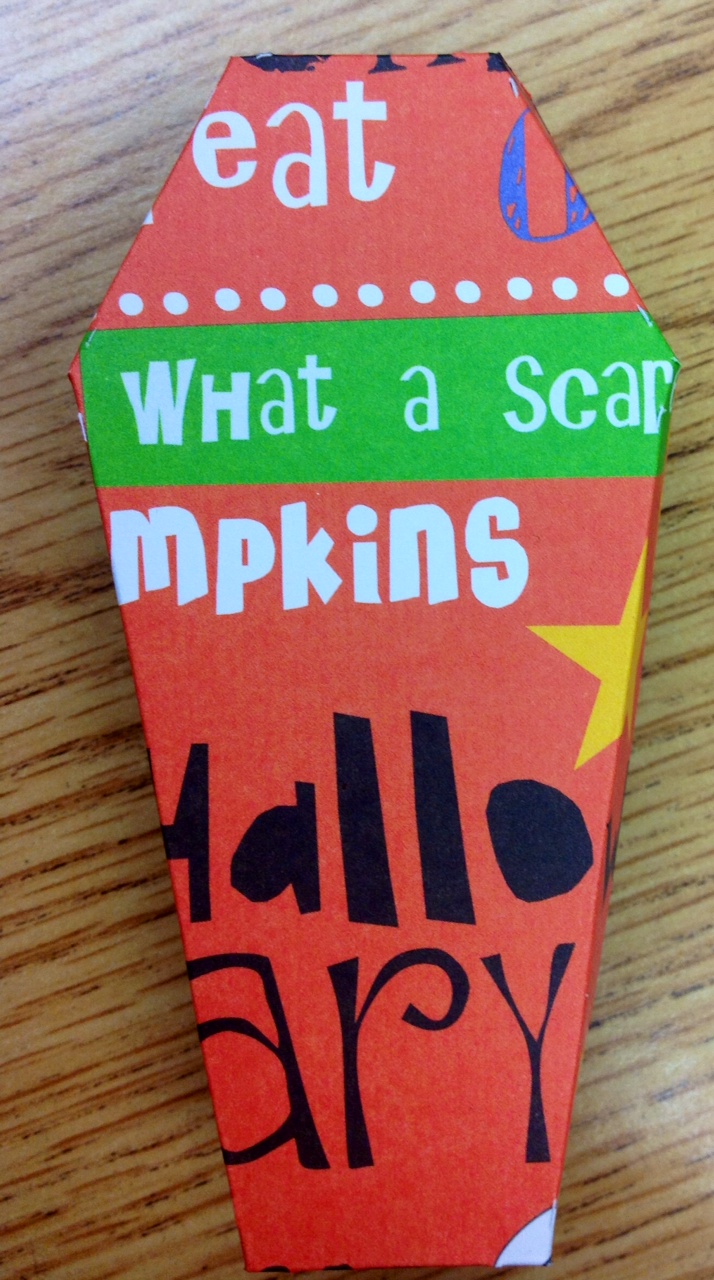
coffinBy coincidence [NOT], one of the many talented and creative members of my work staff gave me this paper coffin she made using her Cricut.  I am going to take that add some food (a sort of libation coffin) that represent those foods which do not serve me well including sugar, fat, and etc, and leave it outside for the goblins.  As I prepare it, I will say this little charm:

  • If the use mean, cruel, or rude,
  • Goblins take this bit of food.
  • If I eat to soothe my mood,
  • Goblins take this bit of food.
  • If this is a harmful brew,
  • Goblins take this bit of food.
  • Take it, take it, take it.

As Dorothy Morrison has said many times, the Gods like to be amused so little bits of poetry, and little charms will amuse them and move them to assist us in our magic.  It amuses me too.  She also says that when we do magic, we must also do the things that reinforce the charm.  So on I go to heal my relationship with food.

And finally on this wonderful Halloween Day, I want to leave you with a poem from my childhood.  We lived in Indianapolis, Indiana when I was a small child.  I spent my kindergarten days there and our teacher read a poem by James Whitcomb Riley, the poet laureate of Indiana.  My paternal grandfather was a Hoosier and was very excited about the things we learned about his home state.  This poem, Little Orphant Annie, has stuck with me these many years and I try to read it every Halloween.  So enjoy and may you avoid the goblins of your life!

Little Orphant Annie

by James Whitcomb Riley
Little Orphant Annie's come to our house to stay,
An' wash the cups an' saucers up, an' brush the crumbs away,
An' shoo the chickens off the porch, an' dust the hearth, an' sweep,
An' make the fire, an' bake the bread, an' earn her board-an'-keep;
An' all us other childern, when the supper things is done,
We set around the kitchen fire an' has the mostest fun
A-list'nin' to the witch-tales 'at Annie tells about,
An' the Gobble-uns 'at gits you
             Ef you
                Don't
                   Watch
                      Out!

Onc't they was a little boy wouldn't say his prayers,--
So when he went to bed at night, away up stairs,
His Mammy heerd him holler, an' his Daddy heerd him bawl,
An' when they turn't the kivvers down, he wasn't there at all!
An' they seeked him in the rafter-room, an' cubby-hole, an' press,
An' seeked him up the chimbly-flue, an' ever'wheres, I guess;
But all they ever found was thist his pants an' roundabout--
An' the Gobble-uns'll git you
             Ef you
                Don't
                   Watch
                      Out!

An' one time a little girl 'ud allus laugh an' grin,
An' make fun of ever'one, an' all her blood an' kin;
An' onc't, when they was "company," an' ole folks was there,
She mocked 'em an' shocked 'em, an' said she didn't care!
An' thist as she kicked her heels, an' turn't to run an' hide,
They was two great big Black Things a-standin' by her side,
An' they snatched her through the ceilin' 'fore she knowed what she's about!
An' the Gobble-uns'll git you
             Ef you
                Don't
                   Watch
                      Out!

An' little Orphant Annie says when the blaze is blue,
An' the lamp-wick sputters, an' the wind goes woo-oo!
An' you hear the crickets quit, an' the moon is gray,
An' the lightnin'-bugs in dew is all squenched away,--
You better mind yer parents, an' yer teachers fond an' dear,
An' churish them 'at loves you, an' dry the orphant's tear,
An' he'p the pore an' needy ones 'at clusters all about,
Er the Gobble-uns'll git you
             Ef you
                Don't
                   Watch
                      Out!


Eat, Pray, Love, Rest, Thank, Receive: Some of the Keys to Successful Magic and Life

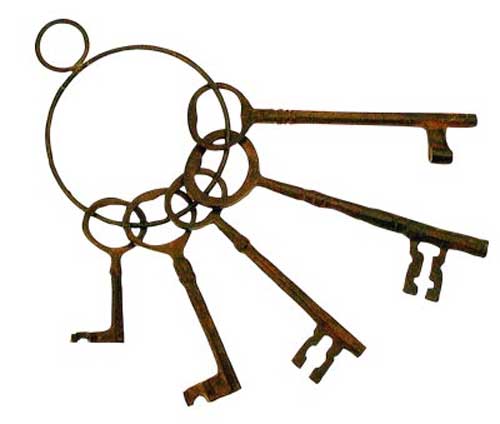
keysThe other day at work, I was listening to a webinair on workplace drama and how to turn around the situation.  The presenter made the point, one that I have heard over and over again for many things, that the only person you can really change is yourself.  In order to turn around drama, you have to change yourself and not be a part of the drama.  Curtains on your participation.

It’s true about drama, it’s true about spellwork, it’s true about relationships.  You really can’t change anyone but yourself.  Many years ago, I took a professional development course on how to deal with difficult people because I wanted to fix the problem at work and fix those other people!  The course was really good.  They presented people as “types” of dysfunction.  I could clearly see my co-workers in some of those types.  Unfortunately, I saw myself as well.  I can’t tell you how much I hated seeing that.  I realized that before I fixed other people, I would need to fix myself.  Using the strategies for dealing with that type of person, I changed my behavior, which, in turn, changed the way I related to circumstances and the people who created them.  By that time, I realized I would never be able to change my co-workers to be the change I wanted to see in the world.  I could only change myself.  I think that’s called maturity, by the way.

The presenter stated that in order to help change the workplace, you needed to exert mastery on your own energy and the way you related to the world.  She was quick to point out that this was not New Age babble but real neuroscience.  I just laughed to myself, because I could see that her points had applications to following a magical path.  She went on to state, tongue in cheek, that if you wanted live in drama and dysfunction, all you had to do was not do anything to master your energy:  never exercise; eat junk food; work incessantly; procrastinate; and never ask for help.

I began to think of how this applies to our spiritual lives.  I reframed as positive actions, and it’s very similar to much of what others write, and continues to make the point, that in order to live a life in harmony with the Universe, you must have practices in harmony with the Universe.  See, obvious and simple.  This is what I came up with:

  • Rest, eat well, and exercise your body and mind
  • Keep a balance between all the areas of your life including work, rest, and play
  • Ask for help and accept it
  • Be grateful for what you are and what you have
  • Give back to the Universe and the causes you care about
  • Be generous
  • Know yourself and set good boundaries
  • Be willing to receive
  • Express love, joy, Spirit, and gratitude in the ways that fulfill you

It sounds more than a little like Scott Cunningham’s 13 goals of a Witch, doesn’t it?  Each of us are guided by our internal moral compass which has grown from our ethical knowledges and practices.  There are many such lists about witchcraft and each of us will integrate it into our being in unique ways.  Having read students’ perceptions of the 13 goals for many years and having lived a few decades beyond Cunningham, I can say that years of teaching and living la Vida Wicca season my understanding of the goals.

Over and over again, we are told and we read that success in spellwork and ritual is based on our intention and focus.  Where does that intention and focus come from?  It comes from the heart of our energy.  If we are unable to master our energy of living well and living spiritually, then its is very likely that our intention and focus is diffused.  That’s it.  Simple.  Obvious.  And dammit, I have to work on myself some more.

May joy, peace, rest, and nourishment be a part of your day everyday.

Tchotchke Oracle: Rocking the Magic of Everyday Things

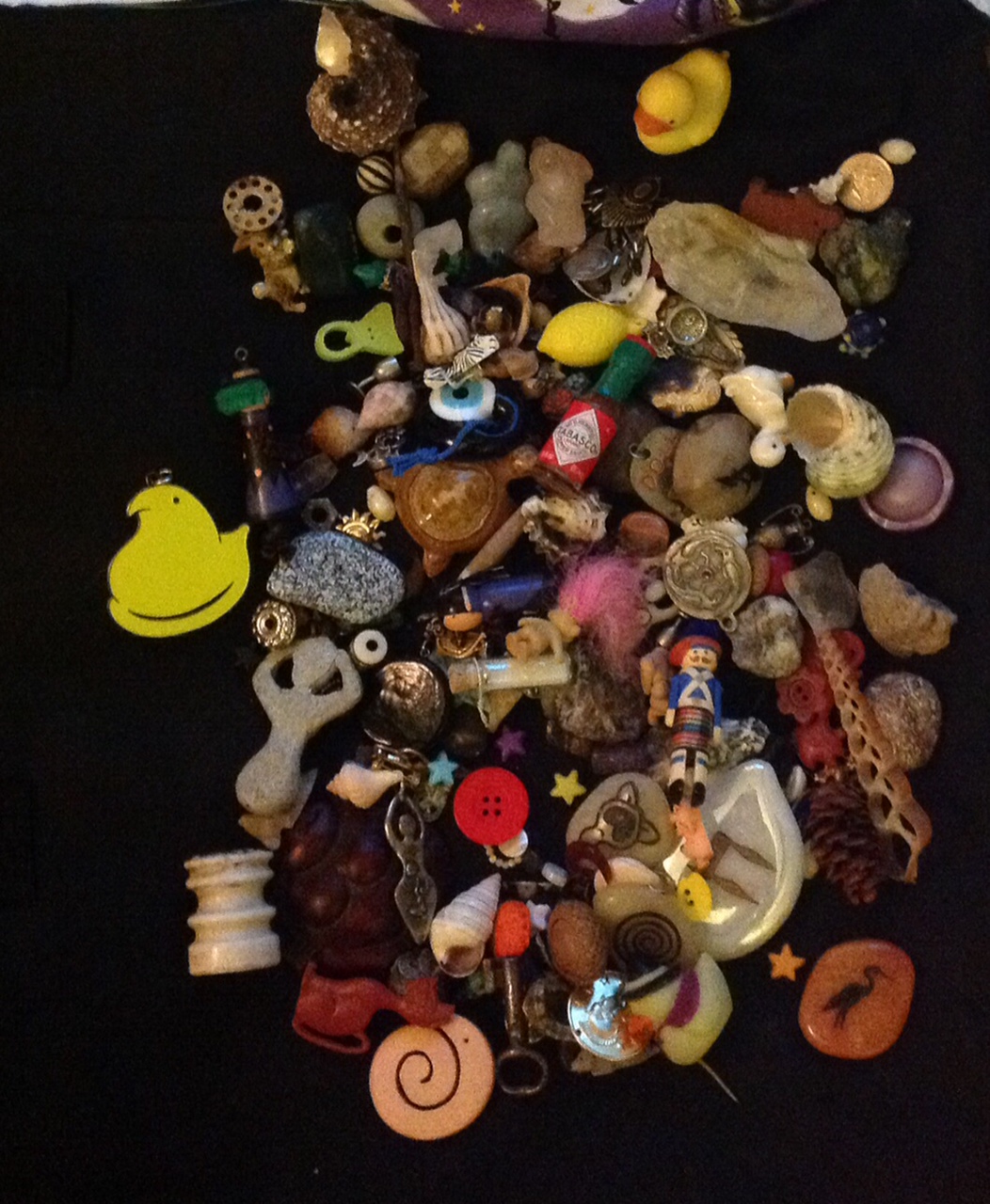
contents of tchotchke oracle

Tchotchke Oracle

As we enter the path of Wicca, Paganism, or adopt a new divination system, we enter a new world of exploration, and of shiny objects and alluring collections of really neat things.  Garb, cloaks, fantastic objects, athames, wands, and so much more.  We can be lead to believe that we need the perfect cloak, the ideal chalice, and all the other accoutrements available.  I once quipped (and have never lived down) that this is the shopping religion.  The same was true, I might add, of mainstream religions.  When I was a Christian, I spent a great deal of meager salary on the perfect leather-bound Bible with gold-edge pages in exactly the right translation.  Then I accumulated more translations and commentaries.  None of these things deepened my walk with Deity; study, communication, fellowship, and prayer did that.  The same is true of the Pagan path.  It is our actions and connections that bring us closer to Spirit. Deborah Blake writes about this online and in her book, Witchcraft on a Shoestring.    She presents practical and frugal ways to practice our Craft along with ways to be authentic and magical.
I once heard Ted Andrews speak and he said that nature is speaking to us all the time and that we need to turn our minds and our ears to hear a new language.  I think the same is true with objects.  The objects we have in our lives accumulate meaning and symbolism that mean something to us personally.  We can read that meaning and let the objects talk to us, help us solve or problems, or lead us to new insights.   This idea was further verified when a friend on Facebook, Morewenna, posted a picture of her Magpie Oracle.
Her posting spurred a lot of conversation and discussion and I realized I could do this too.  I would name mine Tchotchke Oracle for several reasons.  Tchotcke is fun to say, my father used to pepper his talk with Yiddish phrases picked up from people he met in his gregarious ways, and I grew up in an area rich in Jewish lore, customs, and humor.  One woman told me her fiance defined the word tchotchke as “cute little things” and he referred to his balls as tchotchkes.
Kristen Madden in her book, Magick, Mystery, and Medicine has an activity she calls a junk walk.  Go outdoors and with your spiritual mind notice things for your junk bag.  Ask permission to take it with you, and then add it to your bag.  This bag and the contents can guide you and the nature spirits will talk with you through the contents.
I went around my house cleaning out draws, crannies, and other hidden places for little things to put in my oracle.  These things reflect my eccentric interests, hobbies, spiritual path and family life.  There are charms, shells, buttons, and all sorts of items.  I am proud of the fact that I didn’t have to buy a things, not even the bag.  It is large.  Plastic, manufactured, useful, and not useful were all part of the oracle.  I did a little ceremony in front of my altar to welcome the wisdom of the oracle into my life.
I’ve used it in several ways.  I had the members of a shamanic class I was leading put together their own oracle bag.  We were exploring a particular question so each of us drew objects from our own bag and talked about what it said in relationship to the question.  Since the amalgam of our insights were not clear, we drew a map to represent the question since it was centered on a place.  We then closed our eyes and tossed (gently) our objects onto the picture.  I then drummed and we journeyed to the place and explored our question.  Our journeys and the objects intertwined and overlapped, giving us all deeper insights into the complex question we were exploring.
I’ve drawn objects at random moments when I’ve needed a lift, at a time of reflection, or just fooling around.  I have laid out objects in a pattern used for Tarot so each object serves a role or poses a question.  I then read the objects in relationship to their position and then as a collective message.  Sometimes the oracle speaks clearly, sometimes eloquently, sometimes mysteriously, and at other times, just kicks my butt.  I’ve used it in tandem with Tarot, my divination tool of choice to augment a reading.
Others, such as Carrie Paris , have developed oracles according to other systems such as Lenormand.  On her website, she provides a free sheet that you can download.  You then place your charms, objects, and tchotckes and read it in relationship to whatever you are exploring.
This time of year is one of two where the veil between the worlds are the thinnest.  The messages and omens from the other realms are more easily accessed.  It is a time of ancestors, death, harvest, waning times, and preparation for hibernation (retreat).  Every time is a good time to reach out, this may be an easier time.
Wishing you an open heart, ears to hear, and eyes to see.  May the Spirits speak their love and blessings to you!


Enriching your Tarot Visual Vocabulary

Strength from Labyrinth Tarot

Strength from Labyrinth Tarot

When you practice anything, whether it be a musical instrument, a spirituality, an exercise program, or a divination practice, you sometimes have to mix it up to keep from getting stale and stuck in routine.  You can mix it up by learning new things, looking at something with a beginners mind, or by expanding your skills.  Tarot has a rich heritage of lore, history, visual images, and traditionally assigned meanings.  Moreover, Tarot is a place full of exploration, experimentation, building new meanings, vision, and voice.  I often tell my students that each deck has a voice and you need to learn to hear the voice and then translate it into meaning, for yourself and for others.  How do you do that?, I’m often asked.

One way is to employ Visual Thinking Strategies (VST), an active teaching technique.  I learned it in the context of leading it with a group.  Today, I’m attempting to explain how I employ these techniques when I am alone and learning a new deck.  It’s part knowledge and part intuition as applied this way.  I imagine the scholars that develop would cringe at this little bit of Unverified Personal Gnosis!  We live in a society where we are bombarded and saturated with visual messages, and yet we are not always literate in the language.  This has helped me be more fluent in visual language.  It helps as a Tarot Reader.  If you read all the time with the same deck, it’s important to keep it fresh, as you know.  This helps expand your vocabulary and look at an old friend with fresh eyes.

Visual Thinking Strategies is used by art educators to help people interpret what they see in front of them, do develop an artistic vocabulary, and to aid in better expression, either verbally or in writing.  It is usually a facilitated discussion process that encourages depth of analysis.  VTS is centered on students and is an experiential process.  Students are looking at the primary object, not secondary sources or critical analyses.  Participants are encouraged to develop a new vocabulary and VTS provides a structured approach to construct new meaning.

It is a simple process and I’m going to describe how a facilitator does this and then give you some ideas of doing this when you are alone with your cards.  The facilitator presents the groups with a painting or other kind of artwork and says, “Take a minute and look at this picture.”  After a minute, asks “what is going on in this picture?”  As the students gives their response and the facilitator paraphrases their responses and points to what they have pointed out.  Then the facilitator probes deeper, “What is going on in this picture?” When the students respond, the facilitator asks, “What makes you say that?”  When the responses reach a lull, the facilitator goes for even more depth by saying, “What can we find?”, and then continues, making links to previous statements about the image.

Three things are happening here:  Paraphrasing, Pointing, and Linking.  Each is an important part of the process of hearing the voices of the images.

Paraphrasing helps students understand that their thoughts are heard, understood, and valued.   In addition, they can see their idea grow and contribute to the group understanding as the conversation goes on.  This kind of technique is inclusive and creates mutual respect for ideas and interpretations.  It also has the potential of growing an individuals’ vocabulary and ability to see nuance and express nuanced meaning.

Pointing engages the student and helps them to keep actively learning and helps the conversation stay on the image.  Each student in the group hears other students being acknowledged and sees what they have observed, allowing for collaboration.  It also ensures that the facilitator is accurately identifying what the student meant to point out!

Making links between one observation and another builds the ideas and allows the construction of new knowledge and understanding.  It helps everyone stretch their ability to reason and pointing out difference and building the meaning incrementally allows the student to experience the evolution of knowledge and wisdom.

The goal of the session is to have the students leave wanting more, more knowledge, more exploration, and to seek more “answers.”  The faciltator does not summarize, allowing the students to remember or choose what is most important or memorable.  And of course, compliment the students and encourage them for the skills they demonstrated.

As an individual Tarot Reader or student, how can you use these techniques to enrich your understanding of individual cards?  You may want to journal your response and practice on each card a couple or three times.  That way you create a conversation with yourself.  Say, you start on a Monday and repeat on Wednesday, you can look at Monday self and draw a connection,

Take a look at the card at the top of the page.  What is going on in the picture?  What did you see that made you say that.  For instance, I might say that it’s some kind of circus act with a woman and a lion.  I say that because if you look at her body, it/she is not pulling against the lion, but rather placing her open hands on his mouth.  It’s almost like they are doing a very strong, active dance together.  What more can you see?  The rope doesn’t seem to be a restraint, but rather something used to enhance their interaction and it forms an infinity sign.  It seems that the interaction between human and wild is an active one, that is a constant balancing act.  One that combines fearlessness with careful balance and discernment.  For both creatures, the ‘dance’ of their connection is through constant awareness and understanding.

I would stop there and come back and look at it another day.  I’m not terribly familiar with this deck.  On the basis of writing this blog, I went ahead and bought a copy so I could continue my interaction with more “hands-on.”  If you, Dear Reader, try this, let me know how it goes.  It’s fun to do as a group and great to do alone.

Be gentle with yourself and honor all your insights.

A Monday Morning TEAser!

a nice hot cup of tea!

a nice hot cup of tea!

I’ve been away from blogging for a while.  My mother went into hospice last April and passed peacefully away surrounded by her family.  I needed a lot of time to grieve.  I’m still very sad and there’s still a lot of stuff to do, but I wanted to get back to some things I love to do. One of the things that remind me of my mother is tea.  She tried many kinds and always went back to Liptons.  She drank a lot of tea!  When I was a kid, she drank coffee with cream and sugar.  When she started teaching during my junior high school years, she switched to tea.  Story was, that the teachers she hung out with, charged 50 cents for a cup of coffee but tea was free.  Fifty cents was a lot of money for a cup of coffee, so she switched to tea.  And loved it.  She never went back to coffee.

I love a good cup of tea and I like variety.  I’m not a purist, I just like what I like.  To me it’s a mini-retreat in the midst of a busy day.  Tea is also a pick-me-up and an oasis.  I am trying to give up diet soda and now tea is my go-to drink.  Note:  I gave it up for several months but after several long car trips, diet soda was the easiest.  So I will be switching back to tea.

Tea often gives rise to reflections, divination and “deep thoughts.”  Sometimes, though, a cup of tea is just a cup of tea!  Whatever the moment, it is refreshing.

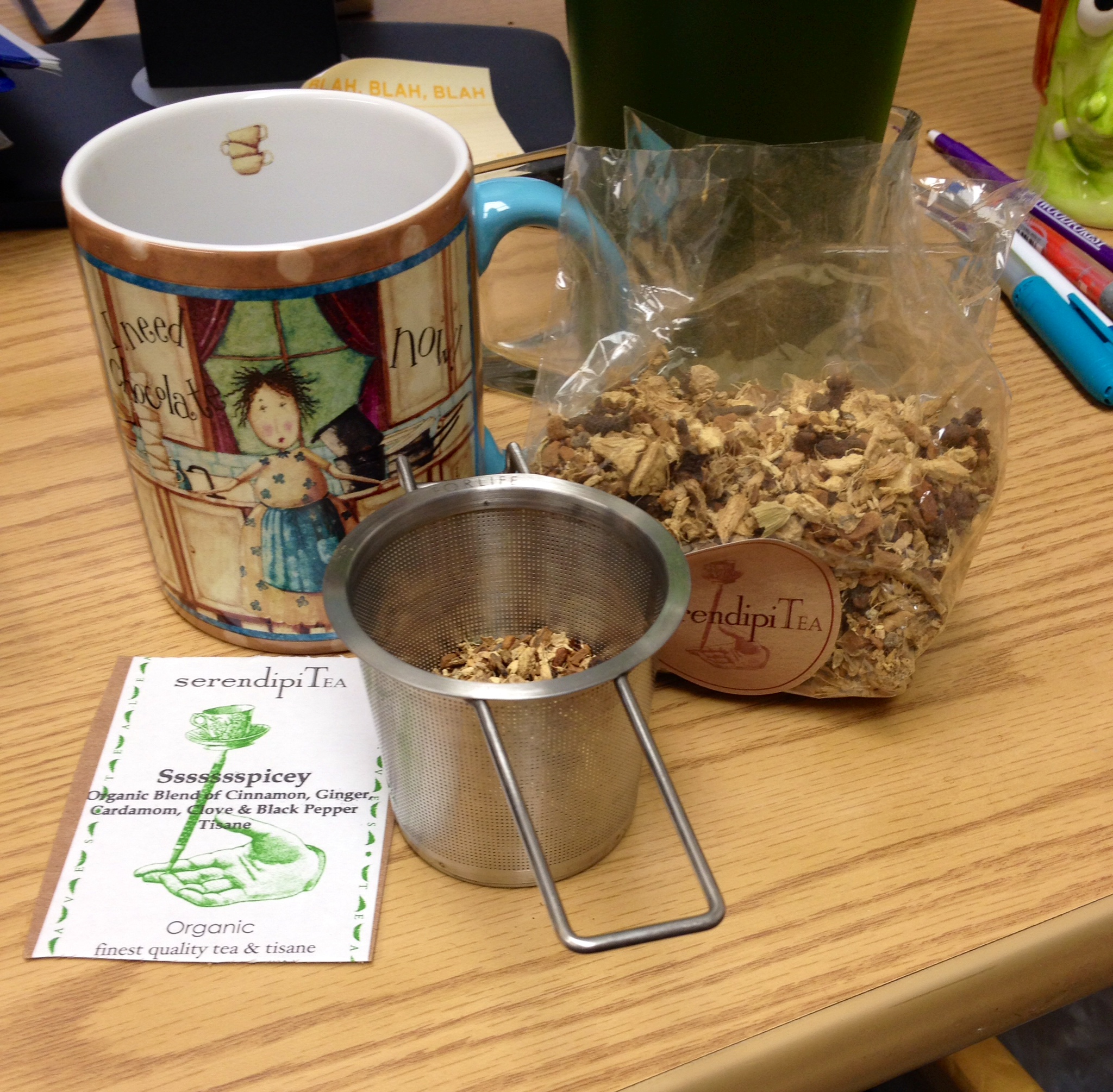
I read somewhere that starting with a spicy drink, such as pepper, cinnamon, or similar tea, can boost your metabolism and help you towards better fitness.  I have several and sometimes I think it works.  Today’s tea is from serendipiTea and is called Sssssspicey, and is an “organic Blend of Cinnamon, Ginger, Clove and Black Pepper.”  Technically, it’s a tisane since there is no tea in the blend.

It is wonderful and VERY spicy.  The blend gives you both a foretaste and a nice afternote.  The spices are very aromatic and just smelling it is an energizing experience.  It certainly is an invigorating tea for a Monday morning at work!  It is definitely effective.  I have gotten a lot done this morning.

As you can see, it’s a loose blend.  As I was sniffing it, I dropped the tea strainer into the brew and my cup was awash with the leaves and bits of herb.  I had to strain it again.  The tea did not guarantee grace or a spell against clumsiness!  Even after I finished the cup, the scent lingered on.

May your Monday be an energetic delight, and end by relaxing into sereniTEA!

Post Navigation